Mouldmaking Today
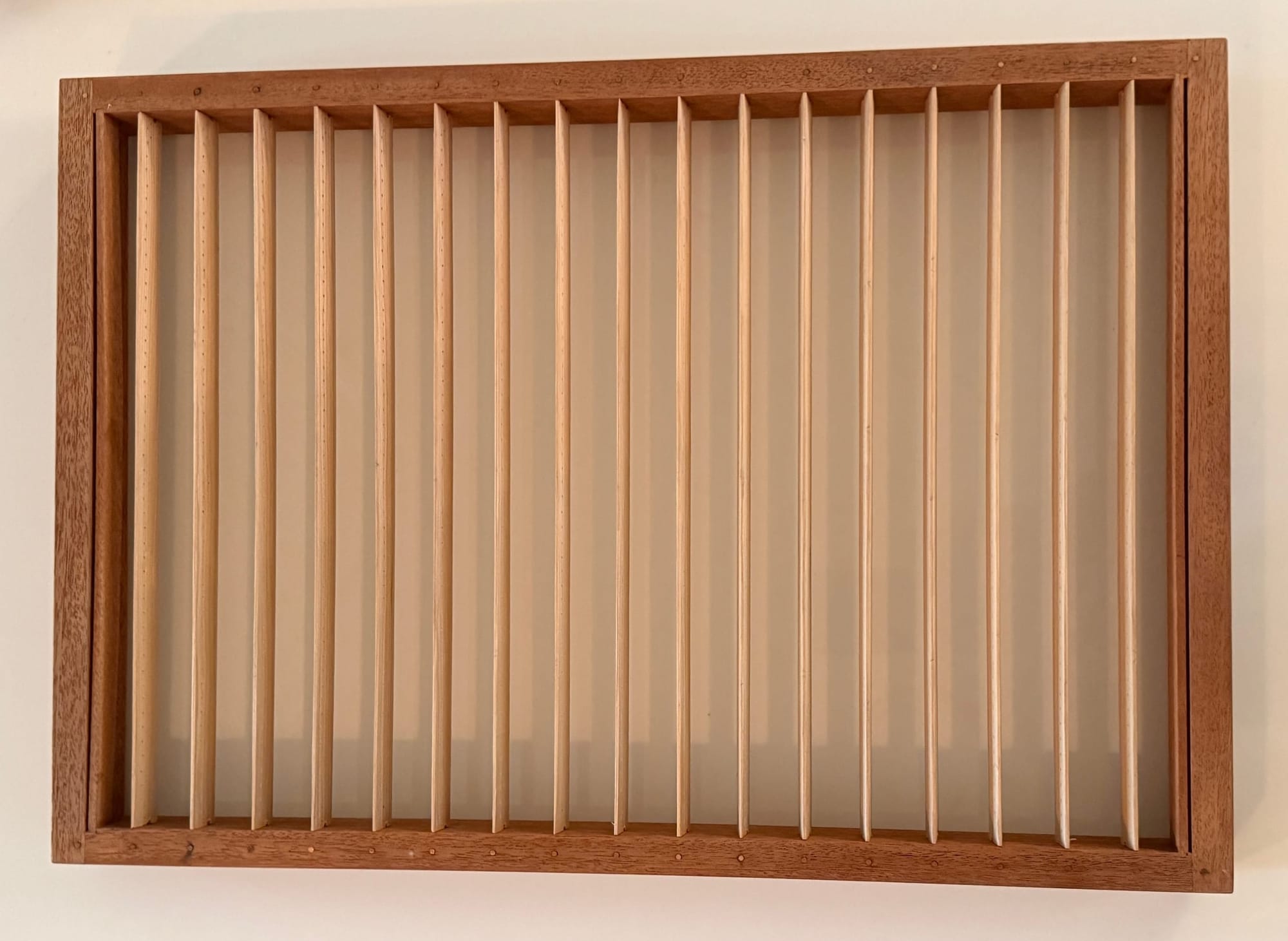
John Jarvis made this wooden mould base in a few weeks this summer, having never made a mould. As I mentioned in the last post, their woodworking skills are quite developed, and were familiar with Tim Moore's blog about mouldmaking. We had hoped to have a finished mould and deckle with the antique wire cover sewn onto the mould to display at the 2026 North American Hand Papermaker's conference in Baltimore. However, having the mould base completed showed John's skills and would still demonstrate our commitment. We felt that this was proof of our ability to provide a high-quality mould. In addition, people would have the opportunity to see a mould frame without the cover sewn on. A discussion of the merits of our endeavor, and mouldmaking today would be instructive for everyone.
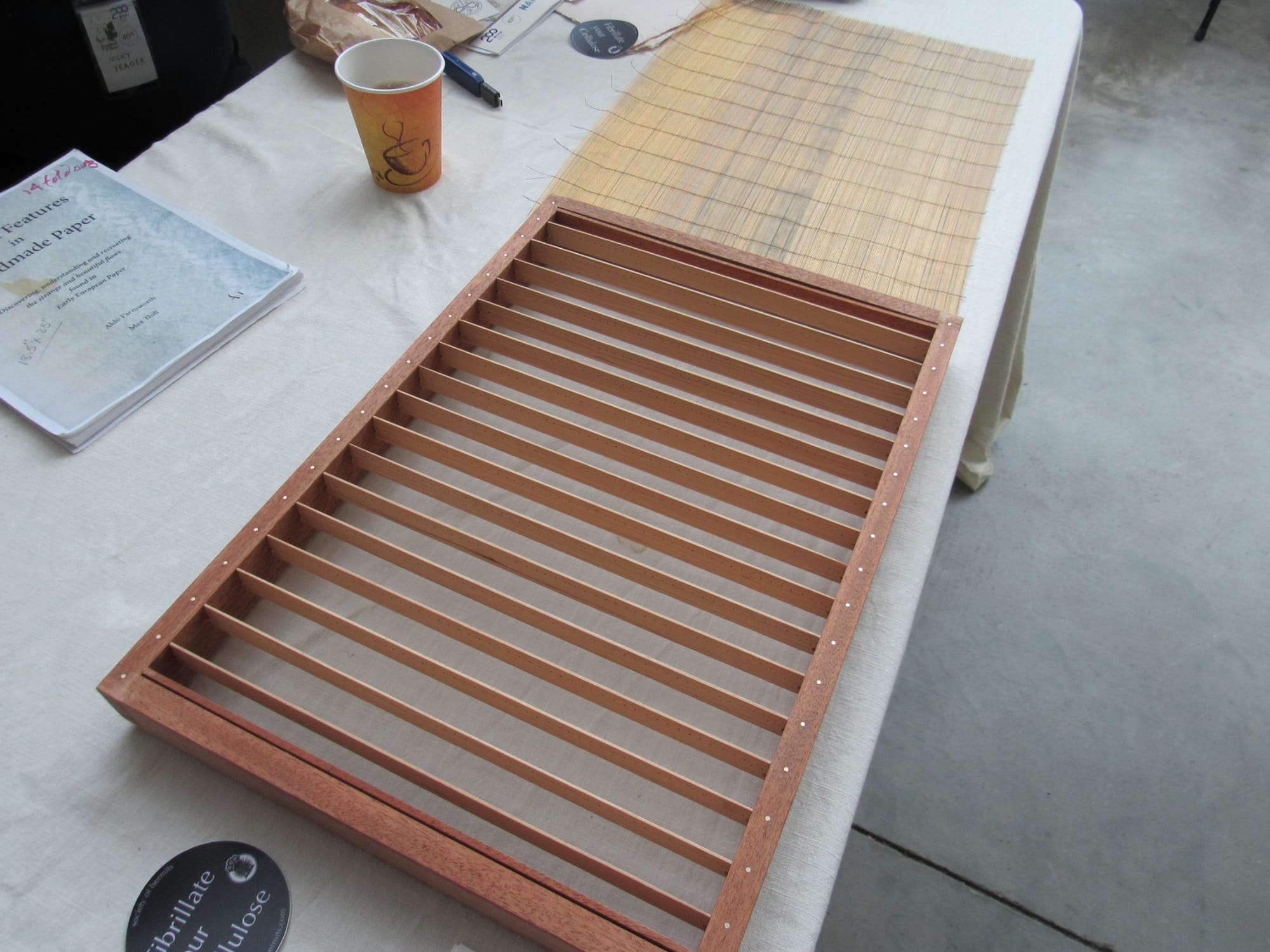
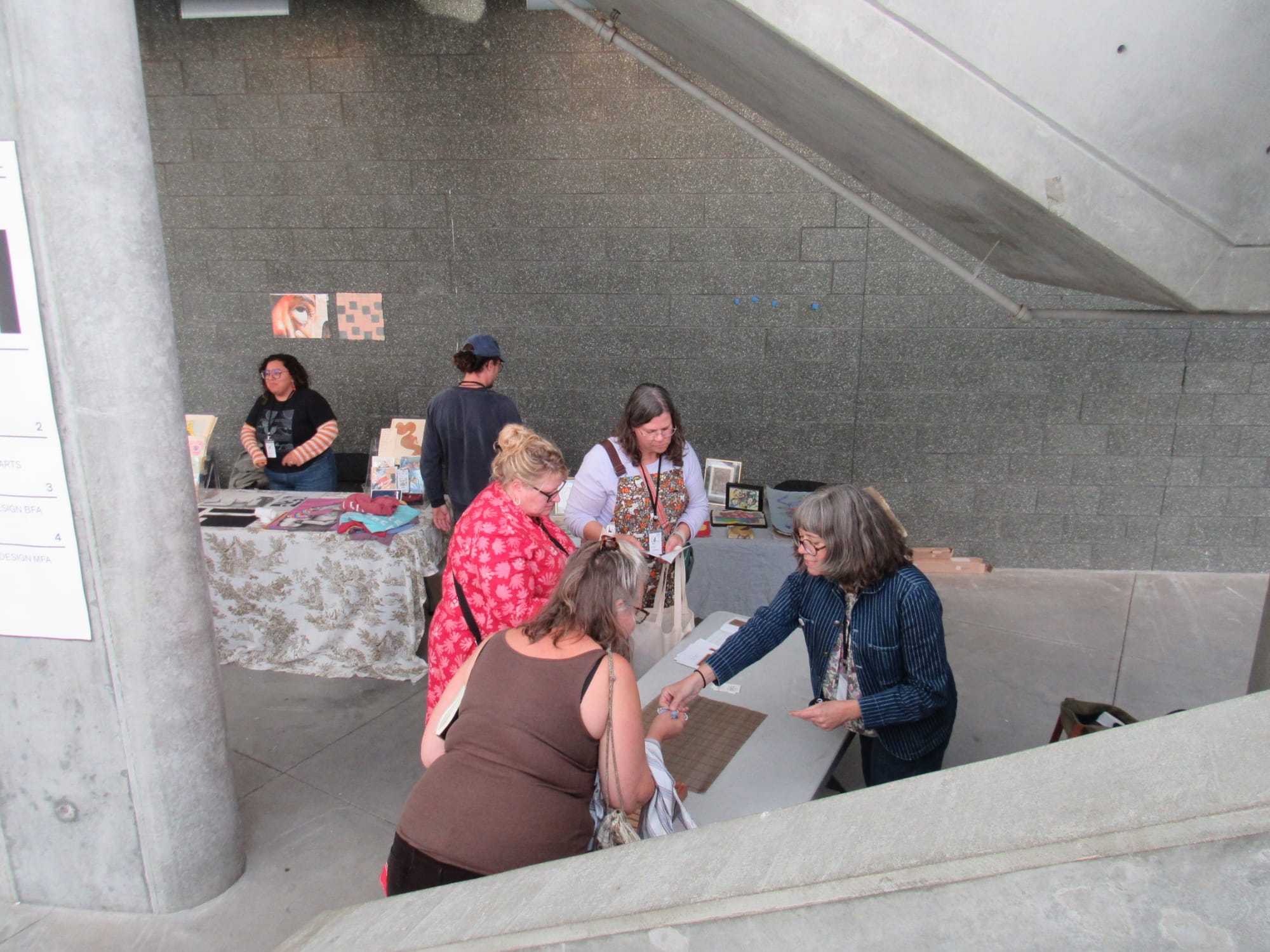
Vendor's area with our table NAHP 2026
Heather Peters had introduced me to John, and agreed to work a vendor's table with me. Heather has been making paper for a dozen years, been a presenter and attended many NAHP conferences, and could speak with authority on why we were pursuing this effort. In addition to having different levels of papermaking experience, Heather and I knew a larger segment of the community than on our own. A good portion of the conference attendees came to our table to discuss our process. Whether new to papermaking, or long-time practitioners, interest in handmade moulds brought them to our table. The discussions ranged from finding resources, building skills - wire weaving, woodworking, etc. - to integration with modern technology to aid in toolmaking.
It is useful to contact people on the industrial side of papermaking to solve supply needs. As artists, we are trying to learn more, extend our reach, and try new things. This can be applied to tools as well, which led to discussions about acquiring the tools we wish to have.
The night before the conference began, I was asked if we could do a demonstration at the conference as someone had to back out. That was fortuitous for us as we wanted to share the process in coming to make moulds. A group discussion of how papermakers acquire the necessary tools to practice their craft seemed worthwhile. It is quite difficult to have an antique laid mould made to order, however, we were determined to do it, and had a few resources that we could draw on to make it happen.
Brian Queen came by early and visited our table a couple of times. He has been supportive of our project from the beginning. I have spoken to him and had numerous emails about the project, and he's answered a lot of questions that kept us from going off track. Brian is always willing to share experience from his many years making moulds, light and shade watermarks, and papermaking in general. His delighted curiosity makes any exchange a treat because one leaves with more insight and direction and a sense of excitement to make paper.
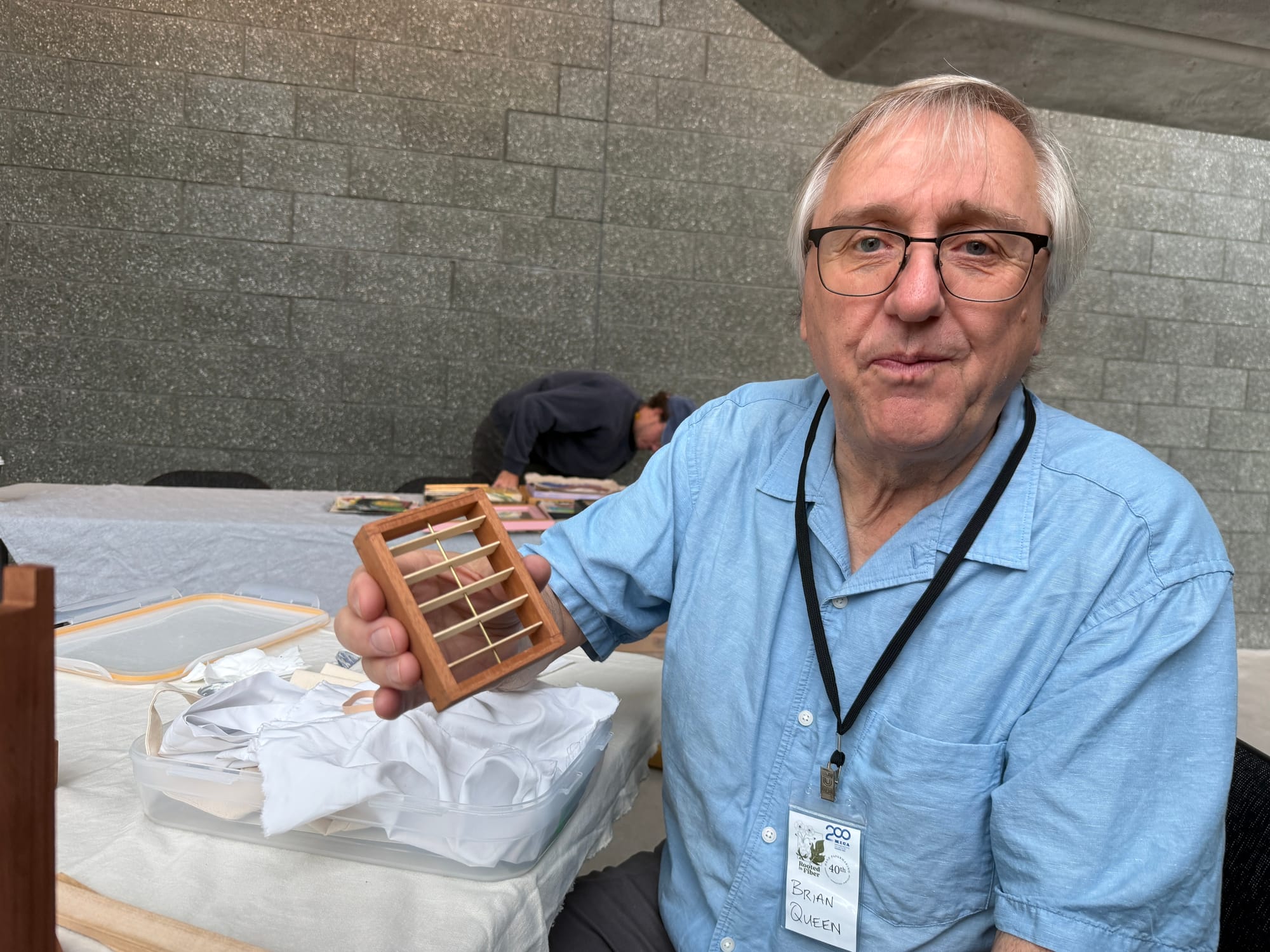
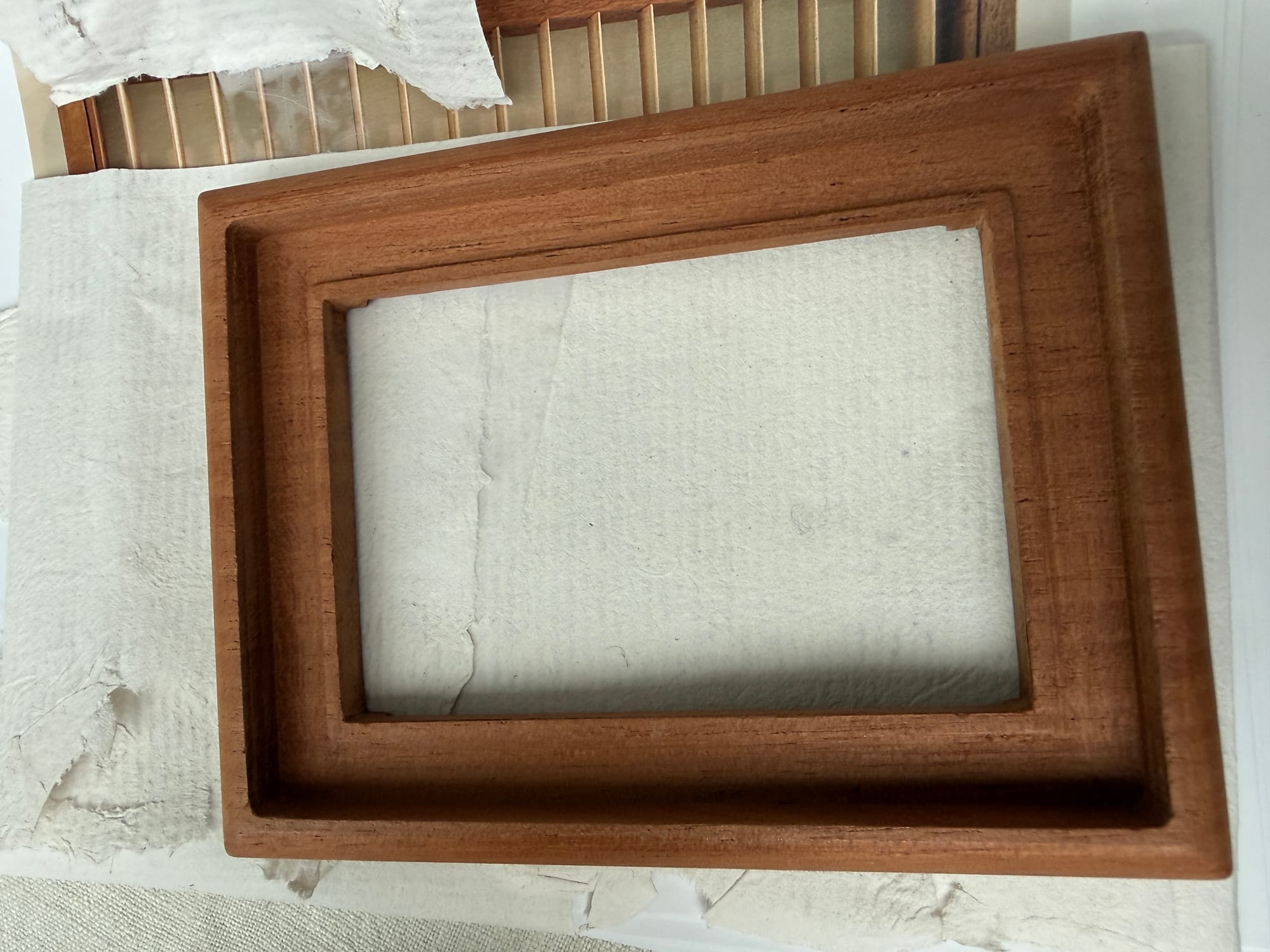
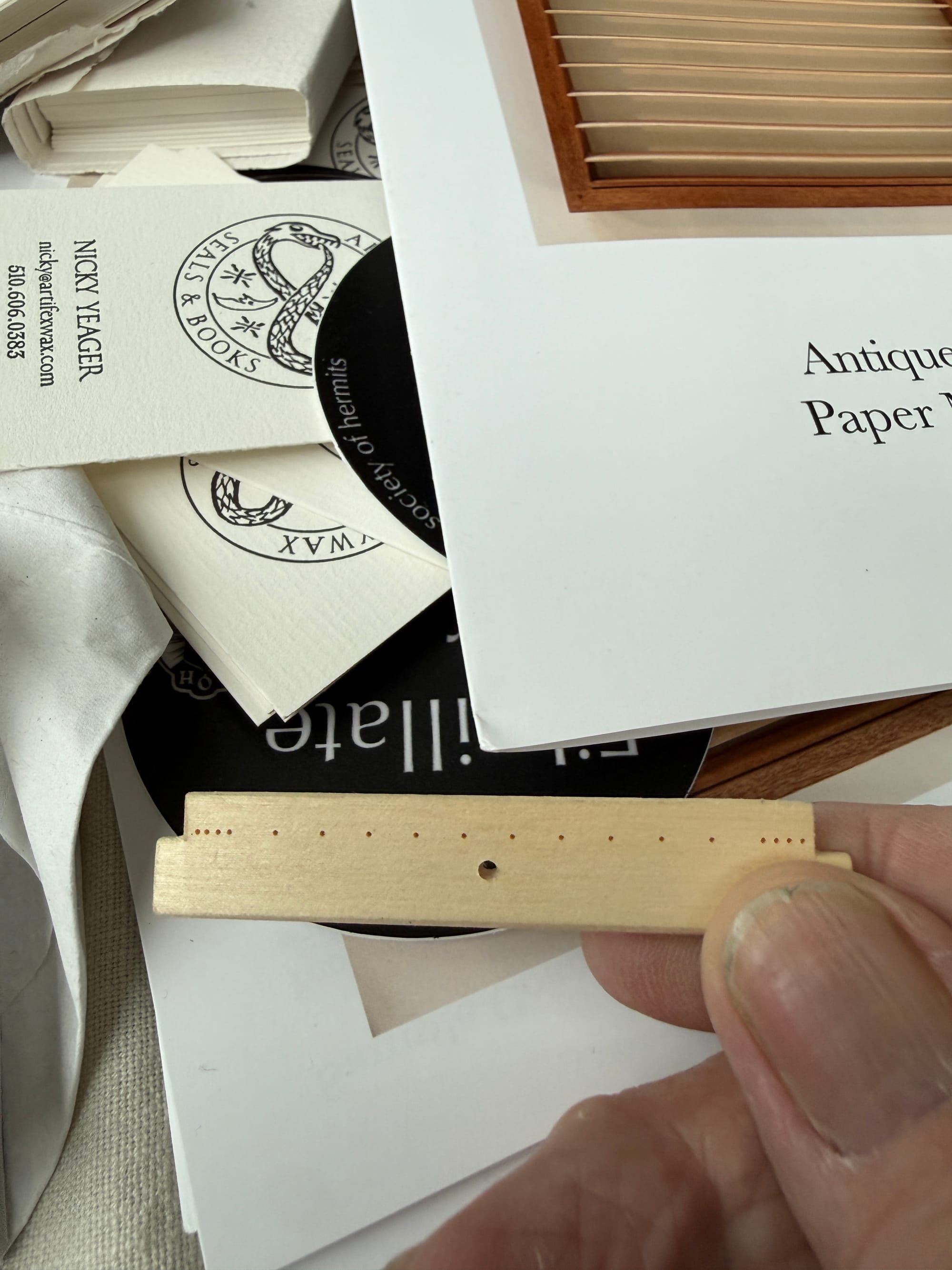
Brian Queen discusses his CNC made miniature mould
As you can see, Brian brought his CNC made miniature mould and we talked about how using CNC fabrication might assist in fine mouldmaking production. The discussion ranged from tool paths to reduce repetitive work in making the ribs, recessing them in the mould sides, and using a very small drill bit to make the sewing holes in the ribs for tying down the cover. Throughout the conference, Brian brought up more ideas, resources, and made useful observations.
It was rewarding to see that there was interest in our efforts with discussions about weaving, woodworking, materials acquisition, and training kept us engaged during the conference. People who teach at institutions asked about ordering after the new fiscal year, and I was able to assure them that we would be able to do that. In my earlier business of making Zorbix, I mostly sold to institutions and understand the procedures involved in working with purchasing departments.
On Saturday, Heather and I gave 2 demonstrations which were quite lively with contributions from the audience, and great questions!
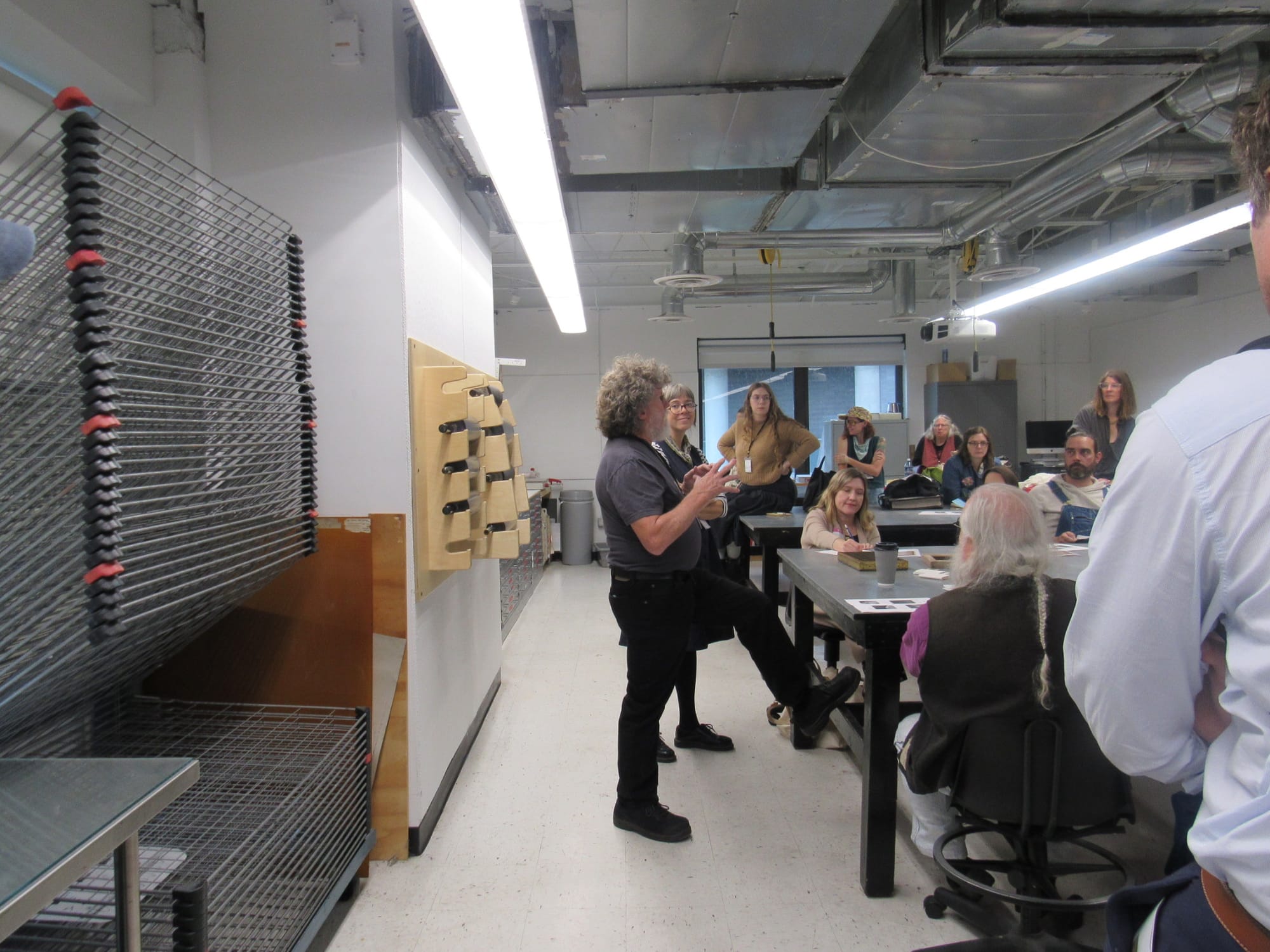
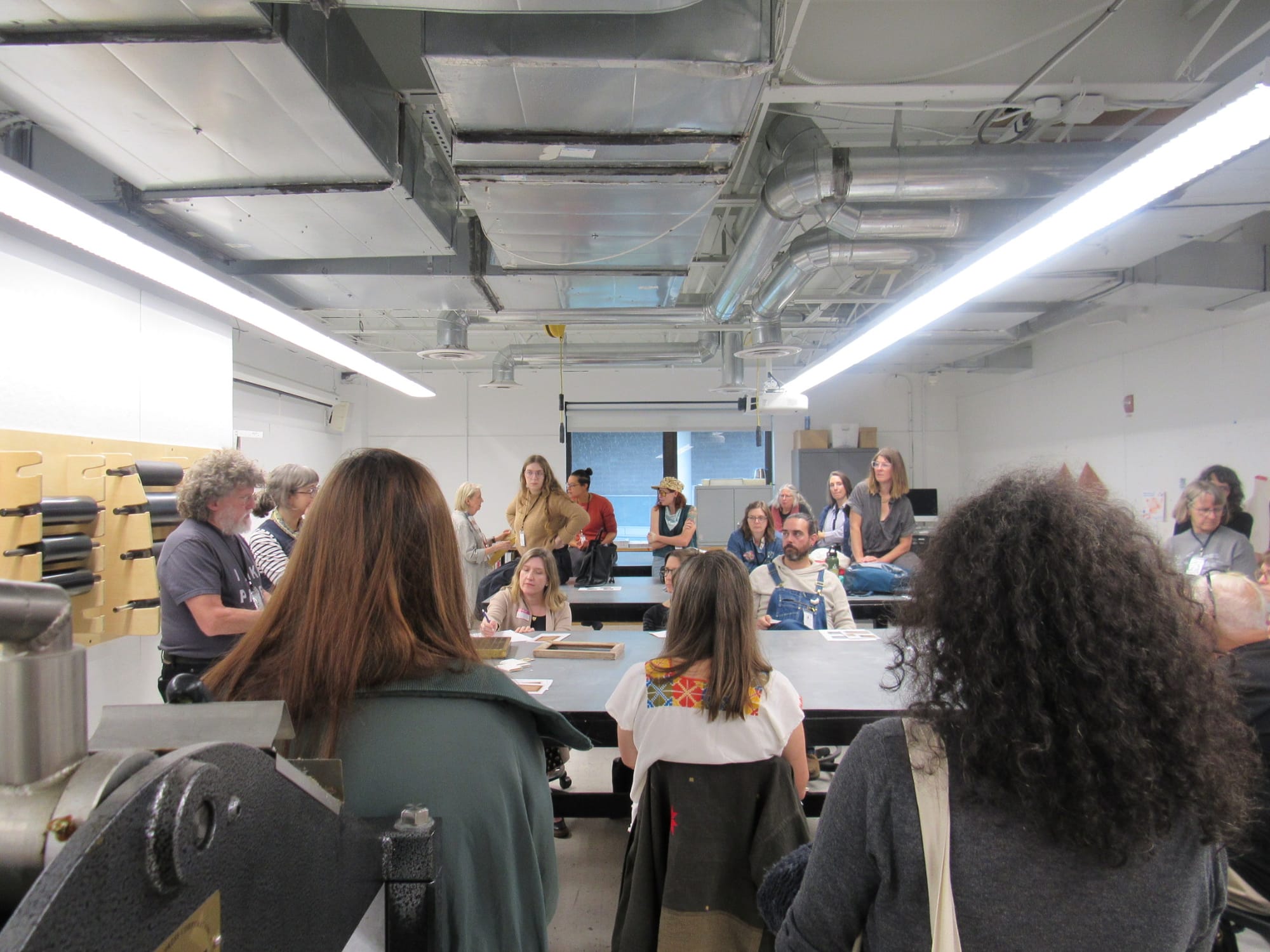
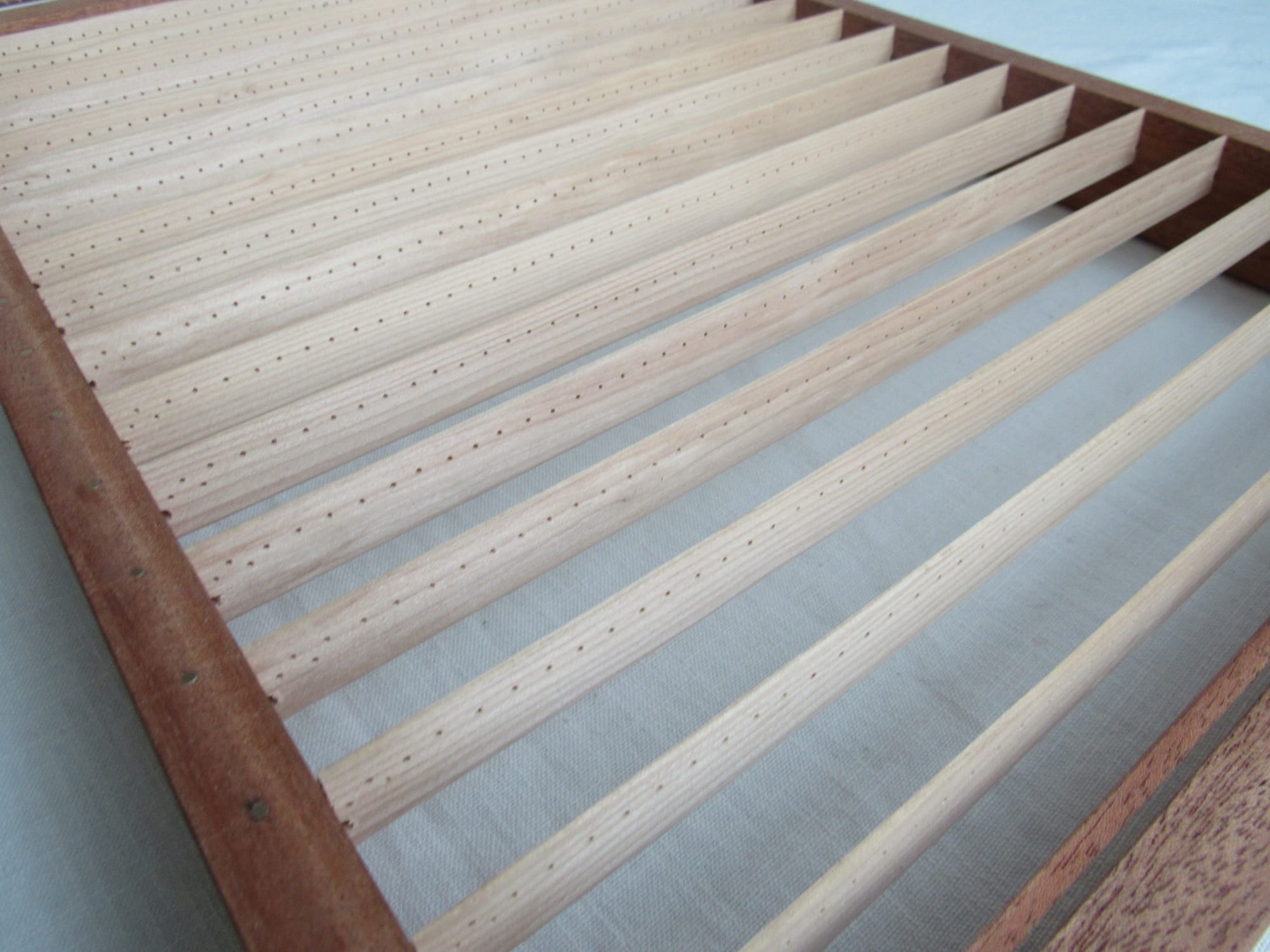
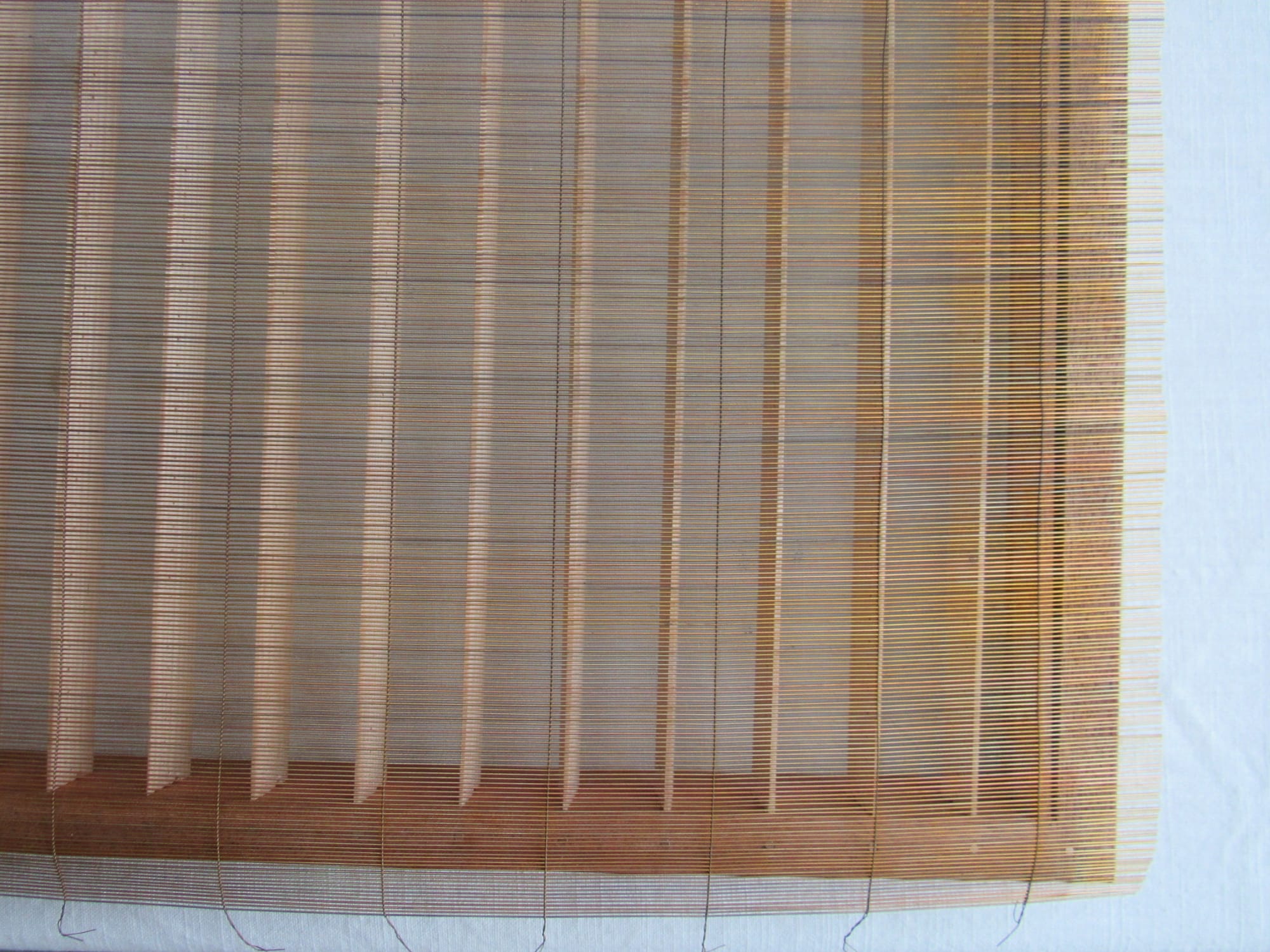
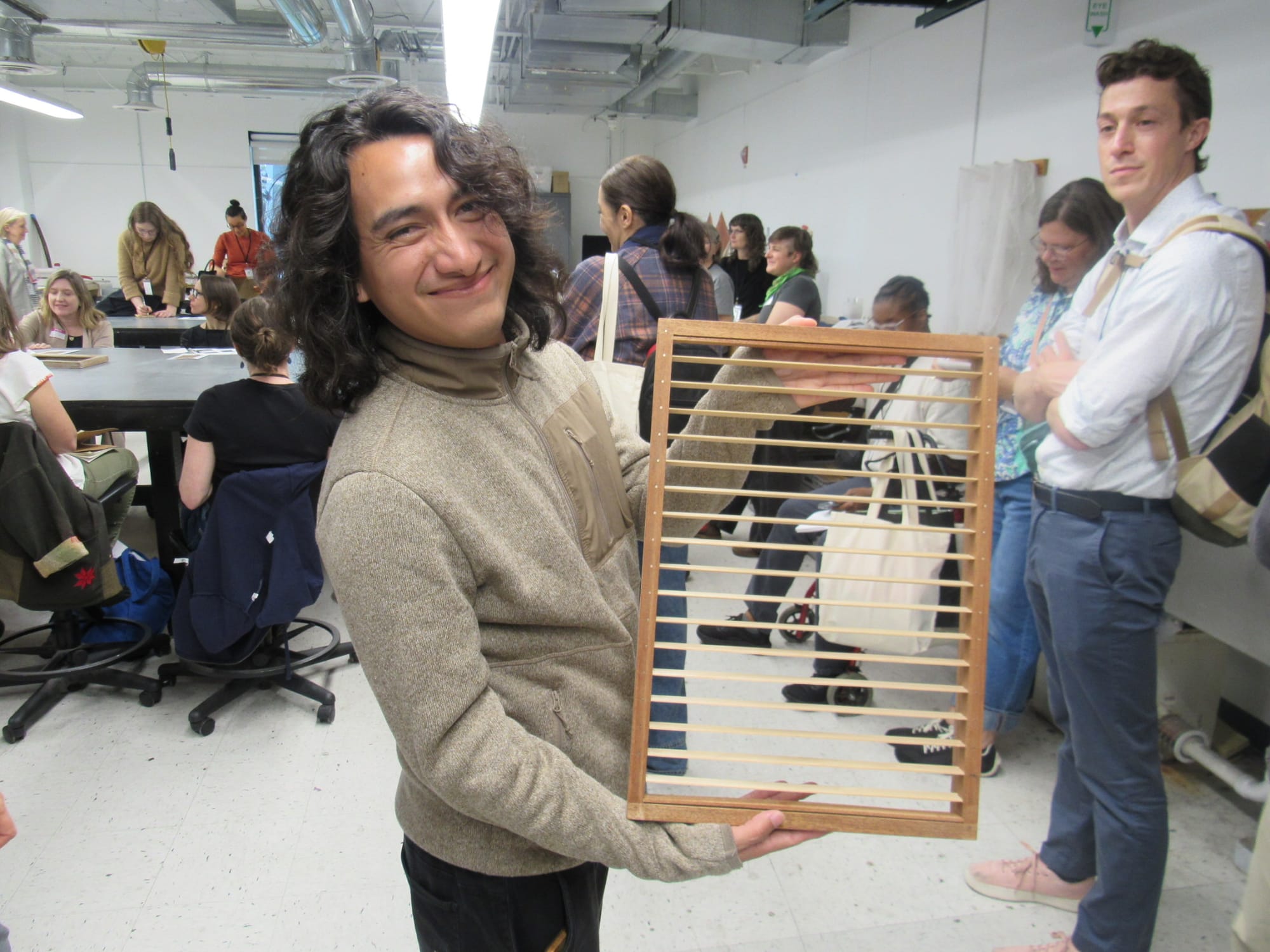
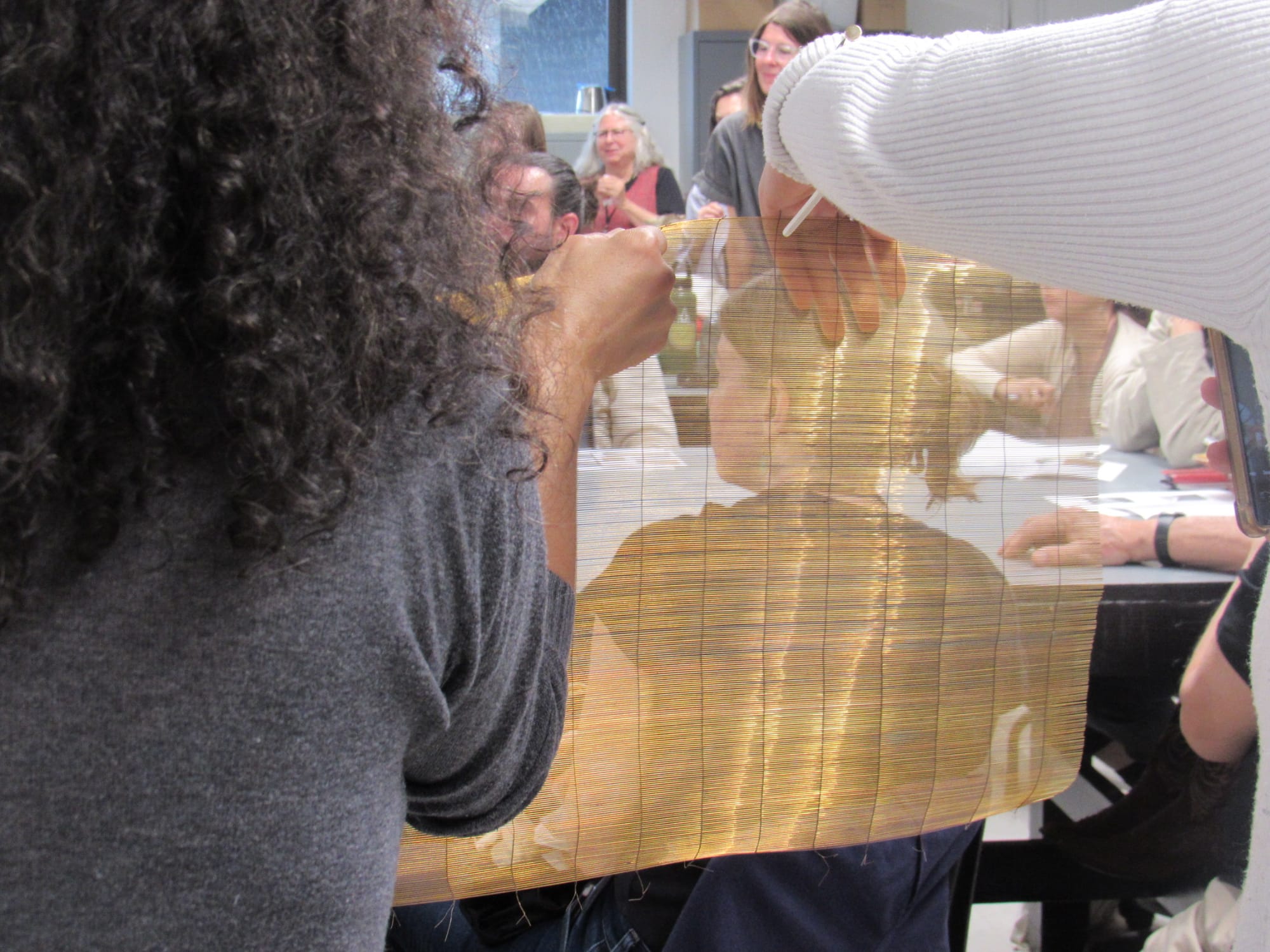
Demonstration of mould and wire cover - Photographs courtesy Izabelle Brandli
Problem solving: does industry have an option? I described how I'd seen Aldo (Don) Farnsworth's use of Johnston Dandy's wire cloth for his moulds. He, and others have purchased remnants from the company's hand-woven phosphor bronze cloth for hand papermaking. I spoke of writing to the company and requesting pricing for available cloth material in various laid line/chain line combinations. Through spending time with their sales staff, I secured pricing that allows us to purchase remnant cloth rather than committing to a full sized piece of cloth. Being able to purchase remnants lowered the barrier to entry as capital is not tied up in a "bulk" order.
Another aspect of solving the problem of how to have well-made traditional wooden moulds was in my willingness to discuss with various woodworkers whether they wanted to take part in this effort. I envisioned having a number of people involved in learning the specifics of making the mould and deckles so that there would be a pool of skilled mouldmakers as well as be able to supply papermakers with moulds in a timely fashion. Waiting years for a mould is frustrating for all concerned; having more than one accomplished mouldmaker improves the opportunities for papermakers who want these moulds.
Finding solutions for suitable wood stock were also discussed. Finding ethically harvested Honduran mahogany is just one of the issues. In addition, I wanted to know what else we could use as wood for the mould and deckle. It's one thing to emulate 19th and 20th century mouldmaking styles and use that tradition's materials, but that closes off the option for other woods that may reflect a longer-term historical solution. Mahogany became the British trade's material of choice because it was good for getting wet frequently, but also because it was in abundance through much of the 19th and 20th centuries.
Tom Bannister has been making moulds with "Costa Rican Teak (Tectona grandis), an FSC-certified lumber that comes from sustainably harvested teak plantations grown on former cattle ranches." His input at the demonstration expanded on the subject of seeking out suitable materials rather than the "standard" mahogany.
We spoke about the longer history of Western mouldmaking where wood harvested locally throughout Europe has performed well enough to produce paper in almost every country in the West for hundreds of years. Moulds are a consumable tool; they wear out with use. there are very few moulds older than 200 years, and very few 100 year old moulds that would be considered useable today. Because of this expendable nature of moulds, they have, historically been jettisoned at the end of their useful life. Generally, the mould facing, or cover, on which a sheet of paper was made is impressed into the sheet and is our main identifier of what the mould looked like. While much can be discerned from examining the cover patter, the tie-down points, and the sheet formation itself, little evidence for mould manufacture (w00dw0rking) is known today. If you'd like to know more, read A Glossary of Flaws and Features Found in Handmade Paper by Aldo (Don) Farnsworth and Max Thill. A free digital publication, it will continue to be updated as more is discovered.
Questions regarding weaving arose, and there were comments about looms, or weaving on the mould itself. Sarah Luko has been teaching historic methods of tool-making at University of Iowa. Current practitioners are interested in building skills to make papermaking tools. While having a tool made by another is a convenience, the ability to make one's own tools is available to any papermaker who has mastered other aspects of craft because papermaking is also toolmaking.
We attempted to answer specifics of the moulds we're offering while encouraging participants to put in the effort to make the effort to get whatever tools or materials they need. Resources are readily available should one take the effort to find them and coordinate manufacture of the tools required to make paper.
Here is the mould offering at present:
Custom antique laid moulds using Johnston Dandy cover material with woodwork mould and deckles made by John Jarvis. Covers sewn to the mould ribs by myself will be delivered within 6 months of order. Our limit of 10 moulds for this "production run" indicates that the project may grow into a different form as skills develop. Pricing is partially contingent on area, with the minimum size mould being 12" x 18" up to an 18" x 26" mould.
Antique Laid Mould 18" x 12"
Phosphor bronze cover sewn to mould – Johnston Dandy wire cloth
$2750 mould & deckle
$ 1375 Deposit
Antique Laid Foolscap 16-3/4" x 13-1/2"
Phosphor bronze cover sewn to mould – Johnston Dandy wire cloth
$3115 mould & deckle
$1507.50 Deposit
As the work goes forward, I'll post a finished mould here with examples of the paper made.